
Blue on Blue
Why one-party dominance is bad for Democrats and the places they run

Los Angeles will have a competitive election for mayor for the first time since 2005. The race will be between two Democrats—one with the full backing of the county Democratic party along with almost every California elected official, the other running an upstart campaign supported by pro-housing groups, local progressives and a hodge-podge of disaffected Angelenos. The incumbent, one of the worst mayors in America and perhaps the developed world, has thus far reacted with indignation about being challenged and nonsensical attacks on the challenger for failures which are the mayor’s own.
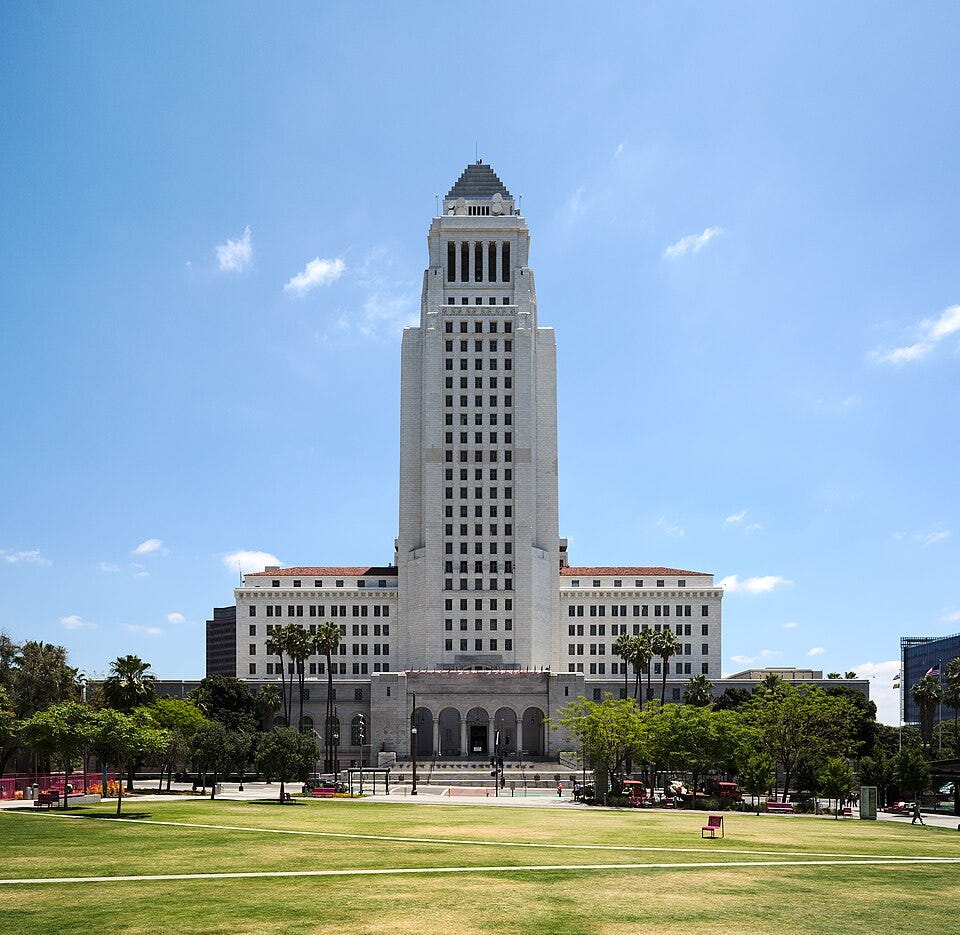
A city like Los Angeles should not have to wait decades for a competitive election as if we are some backwards Third World state waiting for an ailing dictator to die. The performance of the incumbent, and indeed the incumbent party, should be on trial from inauguration day until election day. Democracy works if there is a way to voice displeasure other than just sitting out the election.
Liberal democracy does not thrive in stasis. While it is important that every adult has the ability to vote and that everyone’s vote is weighed equally, simply ensuring that these conditions are met should not be the limit of our ideals.
What makes liberal democracy a superior system of government is that elected officials live in fear for their jobs. If they are not constantly looking over their shoulder and anticipating the moves of some rival, their vision shrinks and contentment with mediocrity grows until it swallows them entirely. Every incumbent needs a challenger or else we’re just living in a modified aristocracy where titles are passed down intermittently.
Parties too need rivals. If we think of parties as networks of interest groups (and we should!), then these networks need separate hubs. Disagreements over policy and disputes over how to divide the pie should be handled in the electoral arena or in an open legislative body. Donors need alternative organizations to fund when they’re dissatisfied with the status quo. The myth of “people power” warms our hearts, but a candidate without institutional backing is not viable.
I’ve been particularly interested in the meltdown LA’s developer community has been having on Twitter throughout this race. This is partly because housing is my area and partly because LA’s cardinal sin for decades has been its adamant refusal to build housing to the detriment of not just the city, but the entire Southern California region. One would think that the prospects of a pro-housing mayor would be music to their ears as obstruction and foot-dragging have become standard operating procedure at both the Planning Department and the Department of Water and Power. You would be wrong.
Instead, LA’s developer community was all in for Spencer Pratt—someone whose big idea on housing is making the homeless self-deport to Seattle, using AI to speed up permitting and opposing density near transit. Pratt also thought that Los Angeles’ massive housing deficit was a “myth” and thinks squatters are behind the reticence of developers to build apartments in the city. Pivoting to his pet issue: law enforcement, where he has similarly vapid ideas, Pratt in a debate said he could build 20,000 apartments in downtown Los Angeles by getting “rid of all the drug addicts that are sleeping on the sides of all these empty buildings.”
One of the worst things to happen to California was that our Republican Party stopped trying. I say this as a Democrat—I donate and am active in my local Democratic Party club. I want the GOP to lose control of Congress this November and I would like to see most members of the Trump administration, including Trump himself, spend the rest of their lives in jail for various crimes of corruption and sedition.
But a California Republican Party that has given up on anything besides being a circus show means that it will stand up clowns like Pratt to run for mayor. Clowns do not really challenge incumbent Democrats; clowns only make fools of themselves. And without a serious challenge, incumbents act like they have no incentive to try because truly they do not.
Perhaps it’s naive to think that in an age of nationalized politics, California could create a palatable alternative to the national Republican Party that could actually compete for voters in a state that went 59-38 for Kamala Harris in 2024. Perhaps conservatives across America, even in California, don’t care about taxation, regulation or public safety—forsaking all of those for the “conservative views that get you cancelled” as that classic Tweet goes. However, I must imagine that at least some conservatives in California’s cities don’t relish the idea of being irrelevant forever. Those people need to do better, for all of our sakes.
Along a similar vein, progressives ought to explore local and state level alternatives to the Democratic Party in the cities and states where the Democratic Party is dominant. The election of Zohran Mamdani in New York City and Katie Wilson in Seattle, as well as the extremely likely election of Janeese Lewis George in Washington D.C. and the serious challenge being run by Raman in Los Angeles, illustrate that politics in America’s urban centers cleaves along an establishment party that caters to incumbent interest groups and a coalition of progressives who have traditionally been shut out of the political arena. That coalition ought to move beyond ad-hoc alliances and start raising its own money, grooming new candidates and targeting vulnerable incumbents.
Moreover, there’s plenty to be done in the suburbs. Witness the Montgomery County, Maryland executive race from 2022. A pro-housing challenger narrowly succumbed to incumbent Marc Elrich, a man who once called apartments near the Purple Line light rail “ethnic cleansing, by a mere 32 votes. Since then, that county council passed a sweeping upzoning ordinance and eliminated parking minimums near mass transit. A new party could organize these reformers and deploy resources where they’d be most effective. All governance, after all, is regional.
We in California specifically would do well to also make our local elections partisan again. As I’ve written previously, party labels are a crucial tool for voters to match their own beliefs to a candidate’s policy positions. It works remarkably well—even better than studying a candidate’s record by themselves and is infinitely scalable, which is useful in elections where people are asked to vote on dozens of different candidates. California could even incorporate some version of New York’s Fusion Ballot which allows candidates to run under the banner of multiple political parties. We are limited only by our imaginations here.
The point of all of this is not to replace the Democratic Party’s hegemony with some better alternative. Rather, the point is to build a better Democratic Party. The mayors and state legislators of today are the Governors and Senators of tomorrow. But these elected officials grow too used to playing the game of politics on easy mode. Steel sharpens steel. The best way to get better Democrats is to start kicking some of them out of office.