
The Second Silicon Valley
The Purpose of a System is What It Does

California’s second tech capital looks like a microchip from the sky.
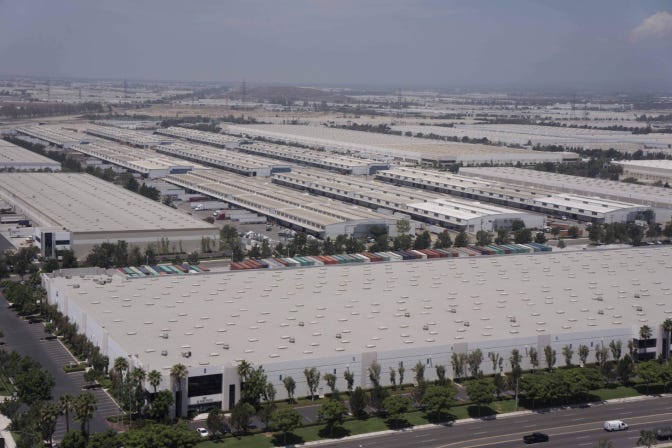
When we think of Silicon Valley, we fixate on what it could do rather than what it does. Technology holds the promise of an eternal future and so it’s natural to always cast our eyes just beyond the horizon. California is a state full of people who arrived looking for something better than what they had left. We believe that magic amulets which fall from the sky have the power to change our lives.
Thus, there’s a natural inclination to focus on the code being written in offices across the Santa Clara Valley. It’s where the future happens, but more importantly, it’s a comfortable vision of the future. The workspaces are sterile, the workers well-kept and the anticipation of a big payout buzzes through the air like it does on any casino floor.
But our second tech capitol is nowhere near those office parks and our real tech workers do not sit in Herman Miller chairs. The valley that starts around the Los Angeles/San Bernardino County Line and extends to the foothills of the San Bernardino Mountains about 50 miles east is where the lines of code move trucks, packages and people.
There are about 1 billion square feet of warehouses throughout the Inland Empire operated by 113,000 warehouse employees. About 40 percent of America’s imports come through the ports of Los Angeles and Long Beach and many of them head to an Inland Empire warehouse for processing. The catch-all term is “logistics” but the Inland Empire’s warehouse economy is better viewed as an appendage of Silicon Valley. It’s the body to a brain—the former requires the latter for instructions and without the latter, the former remains trapped within itself.
I can’t find it anymore, but one of the best articles I’ve ever read about the tech industry was by a man from India who worked in San Francisco. For him, the gig economy was nothing new—as a man in his 50’s he’d grown up with a chaiwalla to bring him his tea and a dabbawala to deliver his lunch before coming to the United States. What drove India’s “wallah” system was pervasive inequality and torpid income mobility. It’s very easy to find people to do menial tasks for little money when there are throngs of poor people with little prospect to ever do anything better with their lives.
The American economy rests upon a fragile foundation of unpriced externalities. Amazon alone employs 40,000 people in San Bernardino and Riverside Counties. Most of these jobs pay pitifully low wages relative to the high-costs of living in Southern California. Moreover, these workers suffer injuries at nearly twice the rate of other warehouse workers—a fact that is actually built into the business model for the warehouses that employ them. Finally, these warehouses are major sources of both diesel and particulate matter pollution that have caused children growing up near them to develop pediatric asthma at higher rates than the rest of the state.
The Inland Empire does have one advantage over other economically depressed areas in this country—its proximity to Los Angeles and Orange County’s affluence. One of just two large metropolitan areas in the state that are actually growing, it has already become the default affordable housing policy for the wealthy coastal cities who’d prefer their servants to live as far away from them as possible. But economic segregation serves a second purpose—it’s created a concentration of desperate and economically immobile people who can feed their bodies to the convenience machine of their higher caste brethren along the shores of the Pacific.
Like the gig worker is just the American wallah, so too is the Inland Empire intimately familiar to anyone who has visited São Paulo’s quebradas, Buenos Aires’ villas or Ciudad Nezahualcoyotl adjoining Mexico City. It’s not just a place for undesirable people, but a place to shunt off the externalities of affluence.
In Medieval England, destitute beggars were hired to ritualistically consume bread and beer over the body of a deceased lord in order to assume all of that person’s sin. The recently departed would thus ascend to heaven blemish free. Meanwhile, the sin eater would live both reviled and feared for the ugliness of their profession.
In California’s second tech capital, the algorithms of the first have discovered how to scale this ancient trade. Now, thousands consume sin with the precision of a Swiss watch. Like a steam engine turns coal into heat and motion, inequality is converted into convenience and profit. And in the combustion process, thousands of Californians and vast swaths of the urban periphery end up as bottom ash.